
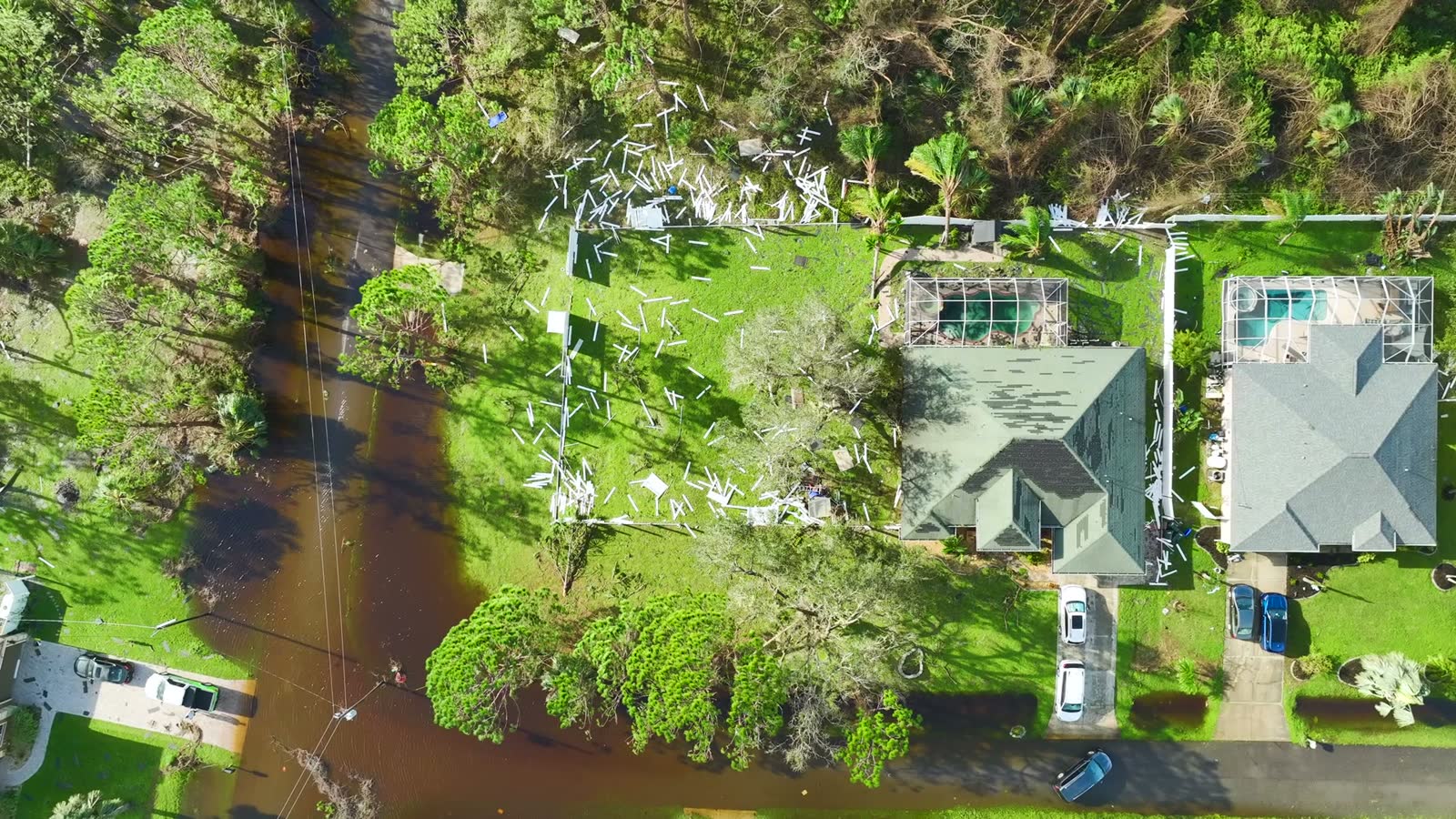
- •Safety first: gas, power, structure, water. No claim step comes before confirming the home is safe.
- •Document before you clean. The most common evidence mistake is hauling damaged materials to the curb before there is a record of them.
- •Then mitigate: tarp, board up, extract water. It is your duty under the policy, and reasonable costs are reimbursed when you keep receipts.
- •If the home is uninhabitable, loss-of-use (ALE) coverage starts now. Save every hotel and meal receipt.
- •Give notice inside the deadline. Florida allows 1 year, but early notice starts the carrier’s 60-day clock to pay or deny.
Safety comes before the claim, always
Nothing in this guide matters more than getting through the aftermath uninjured. Before you photograph a single shingle, clear the hazards a hurricane leaves behind: smell for gas and leave immediately if you detect it; stay clear of downed or sagging power lines and anything they touch; assume standing water may be electrified or contaminated; and do not enter a structure that is visibly leaning, sagging, or missing support. If the home is compromised, stay out and document from a safe distance. The claim will still be there in an hour. Turn off the main breaker and gas supply only if you can reach them safely; otherwise wait for the utility.
Document everything before you touch anything
The instinct after a storm is to start cleaning. Resist it until you have a record. The adjuster values what you can prove was damaged, and the moment ruined materials are hauled away, the proof leaves with them. Before you move anything, walk the property with your phone and capture it in place: wide shots that establish each room and elevation, then mid-range, then close-ups of every damage point. Film video with narration: the date, the room, what you are looking at. Get the roof from the ground, the water lines on the walls, the tree through the ceiling, the standing water at its depth.
This is the after-loss half of documentation; the full method, room by room, roof to contents, with metadata intact, is our photo protocol. If you shot a pre-storm walkthrough, this is the before-and-after that wins the argument about pre-existing condition. Only after the damage is documented do you begin to clean and mitigate.
Your mitigation duty: the clause that cuts both ways
Once the damage is documented, the policy requires you to stop it from getting worse. This is the duty to mitigate, and it appears in the "duties after loss" section of nearly every homeowners policy. It is not a suggestion. Failing to protect the property from further damage can cost you coverage for the damage you let happen.
DUTIES AFTER LOSS · MITIGATION PROVISION (TYPICAL HO-3 WORDING)"In case of a loss to covered property, you must… protect the property from further damage. If repairs to the property are required, you must make reasonable and necessary repairs to protect the property, and keep an accurate record of repair expenses."
Read that clause both ways. It obligates you to act: tarp the roof, board the broken windows, extract standing water, pull soaked carpet and drywall so mold does not set in. And it obligates the carrier to reimburse the "reasonable and necessary" cost of doing so. Florida courts apply the same idea through the common-law doctrine of avoidable consequences: you cannot recover for damage you could reasonably have prevented. The practical rule is simple: act promptly, act reasonably, and keep the receipts.
Temporary repairs: reimbursed; permanent ones can wait
There is a difference between a temporary repair and a permanent one, and it matters to your claim. Temporary repairs (tarps, board-up, water extraction, emergency dry-out, a few boards over a hole) are your mitigation duty and are reimbursable. Do them, document them before and after, and file the receipts. Permanent repairs, a new roof, replaced drywall, reinstalled flooring, should wait until the adjuster has inspected and the scope is agreed. If you rebuild before anyone with authority has seen the full extent of the loss, you may erase the very evidence that justifies the bigger check.
Be wary of anyone who shows up unsolicited offering to "handle the whole thing," especially if they ask you to sign a document assigning your claim benefits to them. In Florida the old assignment-of-benefits abuse is now heavily restricted, but door-to-door contractor pressure after a storm is still a trap. Document, mitigate, and keep control of your own claim.
The first 72 hours, in order
Safe → documented → mitigated → noticed
The order is the point. Safety before anything; documentation before cleanup; mitigation before the second rain; notice before the deadline. The two amber steps are where claims are most often damaged: cleaning before there is a record, and letting open damage sit.
Sequence based on FL/SC department-of-insurance after-storm guidance and standard policy duties-after-loss provisions. Hours are illustrative.
Loss of use: the coverage that pays for the hotel
If the storm made your home uninhabitable, Coverage D (loss of use, also called additional living expenses or ALE) pays the extra cost of living somewhere else while it is repaired. It covers the hotel or short-term rent, the added cost of eating out, extra transportation, laundry, pet boarding, and similar costs above your normal spending. The key word is additional: ALE pays the difference between your new living costs and your ordinary ones. If you normally spend $600 a month on groceries and now spend $1,100 eating out, the $500 difference is the claim, not the whole $1,100.
ALE runs on documentation, so treat it like a second claim from the first night. Keep every receipt (hotel folios, restaurant checks, gas, the lease on a temporary rental) and a simple log of dates. Coverage lasts the reasonable time it takes to repair the home, up to your Coverage D limit (commonly 20 to 30% of the dwelling limit on a standard form, though your policy may differ, so read yours) or a stated number of months, whichever comes first. A mandatory hurricane evacuation order can also trigger ALE even before the home is inspected. This is real money households routinely leave uncollected simply because they did not keep the paper.
Give notice inside the deadline: sooner is better
Report the claim to your carrier promptly, and get the claim number in writing. In Florida, the outer deadlines were tightened in 2023: you must give notice of an initial or reopened claim within 1 year of the date of loss, and notice of a supplemental claim within 18 months (Fla. Stat. § 627.70132). Those are the walls, not targets. Reporting early matters for two reasons: it starts the carrier’s obligation to acknowledge you within 7 days and to pay or deny the claim within 60 days (§ 627.70131), and it forecloses any argument that late notice prejudiced their ability to investigate.
FLA. STAT. § 627.70131 · THE INSURER'S CLOCK, PARAPHRASEDWithin 7 days of receiving a claim communication, the insurer must acknowledge it. Within 60 days after receiving notice of the claim, the insurer must pay or deny the claim (in whole or in part) and give a written explanation of the basis in the policy for that decision, unless prevented by factors beyond its control.
South Carolina works differently: policies require "prompt" notice by their own terms rather than a fixed statutory number, and the contract suit period is generally 3 years. In both states, the safe move is identical: notice now, in writing, and keep the confirmation. For a running countdown against your own date of loss, use the deadline countdown.
The first adjuster works for the carrier
The adjuster your insurer sends, whether a staff employee or a hired independent, is there to value the loss for the company, not for you. That does not make them the enemy, but it does mean the number they produce is a starting position. Handle the visit with that in mind:
- Be there and walk it with them. Point out every damage area, including the ones that are easy to miss: attic, decking, soft flooring, the far slope of the roof.
- Hand over your file. Give them your photos, your pre-storm video, your receipts, and your inventory. Make it easy for them to value the loss high.
- Do not guess. Do not speculate about causes or dollar values on the spot, and do not let a recorded statement put words in your mouth.
- Sign nothing that closes the claim. A release, a "full and final" payment, or a proof of loss with a low number can end the claim before the real scope is known.
If the estimate comes back low, missing decking, underlayment, interior work, or matching, that is not the end. It is the opening of a negotiation that runs through supplemental claims, appraisal, and if necessary the denial-and-dispute process. The stronger your first-72-hours file, the shorter that road is.
Florida vs. South Carolina: the after-storm rules
1 year to notice a claim, 18 months for a supplemental (§ 627.70132), tightened from two and three years in 2023.
Acknowledge within 7 days; pay or deny within 60 days with a written basis (§ 627.70131).
Duties-after-loss and avoidable-consequences doctrine: reasonable temporary repairs are reimbursed; neglected damage may not be.
Generally 5 years on the contract from breach; the notice deadlines above are the front-end gate.
No fixed statutory reporting deadline; the policy’s prompt-notice condition controls. Report immediately to be safe.
A reasonableness standard governs claim handling; the improper-claims-practices law (S.C. Code § 38-59-20) is the conduct backstop.
Same duty-to-mitigate principle applies: document, then protect the property, and keep receipts.
Generally 3 years on the contract. Coastal owners may face separate wind-pool and flood adjusters on one loss.
Statutes and deadlines summarized as of July 2026, and policy-specific provisions can differ. Read your policy and verify current statute text before relying on it.
After the storm: the questions everyone asks
What is the very first thing to do after a hurricane?
Make sure it is safe before you do anything claim-related. Check for gas leaks, downed power lines, structural damage, and standing water that may be electrified. Do not enter a home that is visibly compromised. No photograph or phone call to your insurer is worth your safety. The claim can wait an hour; you cannot undo an injury. Once the home is confirmed safe, the claim work begins.
Should I clean up before I document the damage?
No. Photograph and film everything before you move, remove, or clean anything. The single most common evidence mistake is cleaning up first, hauling out soaked drywall and ruined furniture before there is a record of it. The adjuster pays for what you can prove was damaged, and once it is at the curb, you have lost the proof. Document in place first, then mitigate.
What is my "duty to mitigate" and what happens if I skip it?
Nearly every homeowners policy makes you take reasonable steps to prevent further damage after a covered loss: tarping the roof, boarding broken windows, extracting water. This is the duty to mitigate (courts also call it avoidable consequences). It cuts both ways: the carrier reimburses reasonable mitigation costs when you keep the receipts, but it can deny the additional damage you let happen by not acting. If a hole sits open for a week and a second rain ruins the interior, that new damage may not be covered.
Will insurance pay me back for a tarp and emergency repairs?
Yes, when the underlying loss is covered and you document it. Reasonable and necessary temporary repairs (tarps, board-up, water extraction, emergency dry-out) are reimbursable under the policy. Keep every receipt and photograph the work before and after. Do not make permanent repairs before the adjuster inspects; permanent work should wait until the scope is agreed, or you risk erasing evidence of the full extent of the damage.
When does loss-of-use (ALE) coverage kick in?
Coverage D (loss of use, also called additional living expenses or ALE) starts when a covered loss makes your home uninhabitable, and it pays the extra costs of living elsewhere: hotel or rent, extra meals, added transportation. It pays the difference between your new living costs and your normal ones, up to your policy limit or until the home is repaired, whichever comes first. A mandatory evacuation for the hurricane can also trigger it. Keep every hotel, restaurant, and gas receipt from the moment you leave.
How long do I have to report a hurricane claim?
In Florida, you must give notice of the claim within 1 year of the date of loss, and notice of a supplemental claim within 18 months (Fla. Stat. § 627.70132, as amended in 2023). But do not wait; report promptly. Early notice starts the carrier’s 60-day clock to pay or deny (§ 627.70131) and avoids any argument that late notice prejudiced their investigation. South Carolina policies require "prompt" notice by their terms, with a 3-year period to sue on the contract.
The insurance company sent an adjuster. Does that adjuster work for me?
No. The first adjuster to arrive is usually a company or independent adjuster hired by your insurer, and their job is to value the loss for the carrier. Be present, be polite, and be documented: walk the property with them, point out every damage area, and give them your own photos and receipts. Do not guess at causes or values on the spot, and do not sign anything that releases or closes the claim. If their number is low, that is the start of a negotiation, not the end of it.
- FL LEGISLATURE Fla. Stat. § 627.70131: insurer duty to acknowledge (7 days) and pay or deny (60 days) ↗
- FL LEGISLATURE Fla. Stat. § 627.70132: notice of claim (1-year / 18-month windows) ↗
- FL LEGISLATURE Fla. Stat. § 627.7011: replacement cost and loss settlement ↗
- FEMA / NFIP FEMA: after a flood, staying safe and documenting damage ↗
- UP United Policyholders: ALE / loss of use survivor guidance ↗
- SC DOI SC Dept. of Insurance: after-storm claims resources ↗
Not legal advice; consult an attorney about your specific claim.
The claim is won on the record, not the wreckage.
A hurricane claim isn't decided by how badly your house was hit, but by how well the loss is documented and how precisely the deadlines are met. Photograph everything before you touch it, keep every receipt, put every notice in writing, and read your policy before the adjuster does. The carrier pays for what the file proves.
The deadlines are the trap: Florida gives you a year to notice a claim and 18 months for a supplemental, then 60 days for the carrier's decision; South Carolina runs on prompt notice. Miss the window and the best evidence won't save the claim; meet it, and a denial or lowball becomes an argument you can win. This needs a record, not a lawyer, to start. The free review below is for when the carrier's number doesn't match what you documented.
Fresh off a storm and unsure of the next move?
Send your photos and the first estimate. You'll get a straight read on whether the mitigation, the ALE, and the scope are being handled right, and what the deadline on your loss actually is.