- •Wind damage is covered under the HO-7 manufactured-home form, but often at depreciated actual cash value, not the cost of a comparable new home.
- •Survival turns on HUD wind-zone standards (24 CFR 3280) and tie-down installation (FL 15C-1); improper install is a denial argument.
- •Flood and surge are excluded: a separate NFIP policy is required, and manufactured-home flood take-up is historically low.
- •In a park you own the home but lease the lot; Fla. Stat. ch. 723 governs the split, park closure, and relocation rights.
- •Manufactured homes concentrate uninsured loss: 99% of Homestead’s were destroyed in Andrew, and ACV valuation is the biggest total-loss shock.
Why manufactured homes take the worst of it
No housing type absorbs a hurricane worse than a manufactured home, and the historical record is unambiguous. In Hurricane Andrew (1992), roughly 99 percent of the mobile homes in Homestead were destroyed. Charley (2004) leveled mobile-home parks across Charlotte County. Georges (1998) destroyed 173 homes in the Keys, a disproportionate share of them mobile homes on the lowest ground, and reignited the fight over whether trailers belong in a surge zone at all. In Irma (2017), FEMA found mobile homes and older non-elevated structures fared worst across the Keys.
The reason is age and standard. The federal HUD code took effect on June 15, 1976, and its wind-resistance requirements were sharply strengthened after Andrew, effective in 1994. Homes built before those thresholds were engineered to far weaker wind loads. They are the likeliest to be destroyed and, as pre-HUD units aged, the least likely to carry adequate coverage. Combine that concentrated physical loss with actual-cash-value policies and historically low flood take-up, and manufactured-home households end up carrying more uninsured loss per storm than any other segment. After Georges, FEMA aid, not insurance, funded most of the trailer losses. This guide is about closing that gap.
The HO-7 form and what it actually pays
The standard homeowners form for a mobile or manufactured home is the HO-7 (some carriers use a proprietary "MH" or mobile-homeowners form). It mirrors the site-built HO-3 in structure (dwelling, other structures, personal property, loss of use, and liability), but two differences dominate a storm claim.
The first and larger is valuation. Many manufactured-home policies pay the structure on an actual-cash-value basis, depreciated for age and condition, rather than replacement cost. Because carriers depreciate manufactured homes on a schedule closer to a vehicle’s than a house’s, an older home can pay out at a fraction of what a comparable new home costs, unless the owner specifically purchased replacement-cost or stated-value coverage. The second difference is a set of provisions unique to manufactured housing: transit and set-up coverage, and tie-down and anchoring conditions that tie the coverage to how the home was installed. The valuation basis on your declarations page is the single most important line in the policy; read it before you read anything else.
HUD wind zones and tie-down standards
Whether a manufactured home stays on its foundation in a hurricane is decided before the storm, by the standard it was built and installed to. Federal HUD standards under 24 CFR Part 3280 assign every home a wind zone: Zone I (inland), Zone II, and Zone III (the highest-risk hurricane coastline). Homes destined for Zones II and III must be engineered to higher wind loads, and § 3280.306 requires vertical and diagonal anchoring: ties evenly spaced, straps positioned at studs, anchoring components rated for a working load of at least 3,150 pounds. Most of Florida sits in Wind Zone II or III.
Installation is where the coverage fight concentrates. Florida’s installation rule (Fla. Admin. Code 15C-1) requires every home set after July 13, 1994 to be anchored to its wind zone with frame ties at intervals no greater than 5 feet 4 inches, longitudinal ties, and stabilizer plates on diagonal ties for homes 14 feet wide or wider. When a home is displaced by wind, a carrier may argue the loss resulted from a non-compliant or missing tie-down installation rather than the covered wind peril, an installation-defect theory that shifts the loss off the policy. The counter is documentary: the installation permit, the anchoring certification, and photos of compliant tie-downs. Proof of a permitted, wind-zone-rated installation is the evidence that keeps a displacement loss inside coverage.
Where a total-loss home’s money comes from
The structural problem with manufactured-home coverage shows up when you scale the sources of recovery against the loss. Below is one hypothetical destroyed home, built only to show the shape of the problem: a illustrative $95,000 total loss, split by where the money actually comes from. The uninsured slice is the point.
The wind policy is only part of it
A illustrative example: a manufactured home destroyed by wind and surge. Every bar is a slice of the same hypothetical $95,000 total loss; the length is how much of the loss that source covers. The point is the shape of the gap, not any specific dollar figure.
In this example the wind policy pays 48%, a depreciated slice; flood is a second policy the owner may not carry, and the remaining 20% falls through entirely. The lesson is structural: replacement-cost coverage and an NFIP policy are what close the gap. Your home’s split will differ.
About these figures: the $95,000 total and its three splits ($46,000 wind ACV / $30,000 NFIP / $19,000 uninsured) are hypothetical figures chosen to illustrate how a manufactured-home total loss can be under-recovered. They are not a quote, an average, survey data, or any real home’s claim. Real numbers depend on the home’s value, age, condition, ACV vs. replacement-cost coverage, whether flood is carried, and policy limits. Get a real valuation and read your HO-7 and any NFIP policy. Do not rely on these figures.
ILLUSTRATIVE EXAMPLE · HYPOTHETICAL WIND-PLUS-SURGE TOTAL LOSS AT ACV, NOT A QUOTE OR AVERAGE
The NFIP flood overlap
The HO-7, like every homeowners form, excludes flood and storm surge. Rising water is covered only by a separate National Flood Insurance Program policy or a private flood policy. This gap hits manufactured homes hardest for a structural reason: communities are disproportionately sited on low-lying, inexpensive land, exactly the ground that floods, while flood take-up among manufactured-home owners is historically low. When both perils strike one home, the wind carrier attributes damage to the excluded flood, the flood side caps at NFIP limits, and an uninsured owner recovers nothing for the water.
Two moves protect the claim. Carry the NFIP policy (it is the only coverage that reaches surge) and, when both perils hit, document the sequence and cause: what the wind did before the water arrived, the high-water line versus the wind signature, the timeline of the two forces. That evidence is what allocates a combined loss correctly between the wind and flood policies instead of letting each carrier point at the other. The wind-versus-water allocation works exactly as it does on a site-built coastal home; the stakes are just higher, because the manufactured home is more likely to be a total loss under both.
Park owner vs. tenant: who owns what
In a manufactured-home community, ownership is split down the middle: you own the home, the park owns the ground. In Florida that lot tenancy is governed by the Florida Mobile Home Act (Fla. Stat. ch. 723), which sets the rights and duties of both sides. You insure and own the home; the park owner owns and insures the land, roads, utilities, and common facilities, and is responsible for restoring that infrastructure after a storm.
The disputes cluster at the boundary. Damaged concrete pads, utility and sewer hookups, skirting, carports, and sheds can fall on either side depending on the lease and the prospectus. Lot-rent obligations while the community is uninhabitable become contested. And a severe storm can trigger chapter 723’s provisions on park closure, change of use, relocation, and eviction protections. A park owner who decides not to rebuild after a hurricane must navigate the statute’s notice and relocation requirements, and residents have rights the storm does not erase. Keep the lot lease and the prospectus; they define exactly where your HO-7 claim ends and the park owner’s responsibility begins.
Total-loss valuation
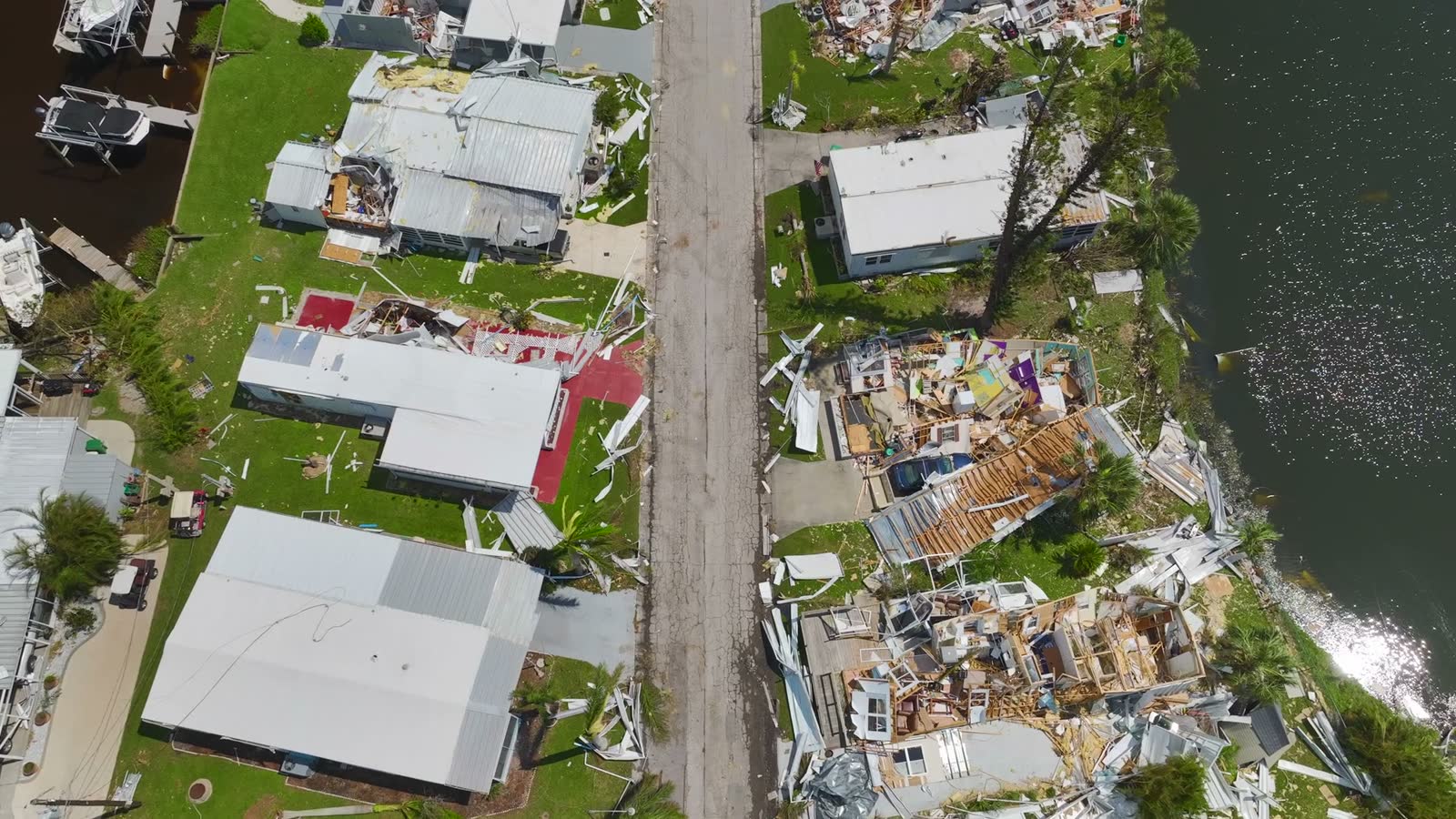
When the home is gone, the settlement turns entirely on the valuation basis you bought. On an actual-cash-value policy, the total-loss payment is the home’s depreciated value: original cost minus depreciation for age and condition, which on an older manufactured home is often a small fraction of what a comparable new home costs to buy, deliver, set, and tie down. On a replacement-cost or stated/agreed-value policy, the payment is the cost to replace or the value fixed in the policy, with no depreciation subtraction.
That difference is the biggest single shock in a manufactured-home claim, and it is why so many households cannot rebuild after a total loss. If you carry replacement-cost coverage, support the claim with the actual quoted cost of a comparable new home plus delivery, set, tie-down, and utility connection: the full cost to make you whole, not just the sticker price. If you are on ACV, scrutinize the depreciation: excessive age or condition deductions on a well-maintained home are a valuation dispute worth contesting, and the burden of a fair depreciation schedule is one the carrier must be able to justify.
The policy language that controls a manufactured-home claim
LOSS-SETTLEMENT (ACV) CLAUSE · TYPICAL MANUFACTURED-HOME WORDING"Covered loss to the manufactured home will be settled at actual cash value at the time of loss, not exceeding the amount necessary to repair or replace, with proper deduction for depreciation and physical condition…"
ANCHORING / TIE-DOWN CONDITION · THE INSTALLATION CARVE-OUT"It is a condition of this coverage that the manufactured home be anchored and tied down in accordance with the manufacturer’s installation instructions and applicable state and HUD wind-zone requirements in effect at the time of installation."
The first clause sizes the check; the second is the lever a carrier uses to argue displacement was an installation failure rather than a wind loss. Both are answered by documents assembled before the storm, the valuation election and the installation permit, not by argument after it.
Documenting the loss
- Prove the installation was compliant. The installation permit, the anchoring/tie-down certification, and pre-storm photos of the tie-downs: the evidence that defeats an installation-defect denial on a displaced home.
- Fix the valuation question first. Confirm ACV vs. replacement-cost on the declarations; if replacement-cost, gather the quoted cost of a comparable new home plus delivery, set, tie-down, and utility connection.
- File wind and flood separately. The HO-7 wind claim and the NFIP flood claim are different policies with different deadlines; document the wind-before-water sequence to allocate a combined loss.
- Map the lot line. Use the lease and prospectus to separate your home claim from the park owner’s infrastructure duty, and preserve any chapter 723 park-closure or relocation notice.
- Notice inside the deadline. Florida: 1 year to notice, 18 months supplemental (§ 627.70132), 60-day decision (§ 627.70131); NFIP flood runs on its own shorter proof-of-loss clock. South Carolina: prompt notice, 3-year suit period.
Florida vs. South Carolina
Install & wind zone
Most of FL is HUD Wind Zone II/III; installation anchored under Fla. Admin. Code 15C-1 (frame + longitudinal ties, stabilizer plates).
Park tenancy
Florida Mobile Home Act (ch. 723) governs lot leases, park closure, change of use, and relocation rights after a storm.
Claim deadlines
1 year to notice, 18 months supplemental (§ 627.70132); 60-day pay-or-deny (§ 627.70131). NFIP flood on a separate federal clock.
Install & wind zone
Coastal SC is HUD Wind Zone II; state manufactured-housing installation rules and licensing govern anchoring and set-up.
Park tenancy
Lot tenancies run on the lease and SC landlord-tenant / manufactured-home-park law; no direct chapter 723 analog.
Claim deadlines
Prompt-notice per policy; no fixed pay-or-deny statute (reasonableness); 3-year suit period; § 38-59-20 backstop.
STATUTES & WIND-CODE SUMMARIZED JUL 2026
Statutes, wind-code references, and deadlines summarized as of July 2026, and policy-specific and installation-specific facts can differ. Read your policy, lease, and installation records and verify current statute text before relying on it.
Manufactured-home claims: the questions owners ask
What is an HO-7 policy and how is it different from a regular homeowners policy?
HO-7 is the standard homeowners form written for a mobile or manufactured home; some carriers use a proprietary "MH" or mobile-homeowners form with similar structure. It resembles the HO-3 site-built form (dwelling, other structures, personal property, loss of use, and liability), with two differences that dominate a storm claim. First, valuation: many manufactured-home policies pay the structure on an actual-cash-value basis (depreciated) rather than replacement cost, so an older home pays out far below the cost of a comparable new one unless you specifically bought replacement-cost or stated-value coverage. Second, transit and tie-down provisions specific to manufactured housing. Read the declarations for the valuation basis before anything else; it decides the size of the claim.
Does my policy cover the home if it blew off its foundation or tie-downs?
Wind damage to a manufactured home, including displacement by wind, is generally a covered peril under the HO-7 form. The complication is whether the home was installed to the required standard. Federal HUD standards (24 CFR Part 3280) set windstorm-protection and anchoring requirements by wind zone, and Florida’s installation rule (Fla. Admin. Code 15C-1) requires homes to be anchored to their wind zone with frame ties, longitudinal ties, and stabilizer plates. If a home was improperly installed or its tie-downs were missing or non-compliant, a carrier may argue the loss resulted from the installation defect rather than the covered wind. That is why proof of a compliant, permitted installation is central evidence in a displacement claim.
Why are manufactured homes hit so much harder by hurricanes?
Age and standard. Homes built before the HUD code took effect on June 15, 1976 (and especially before the post-Andrew wind-standard upgrades that took effect in 1994) were built to far weaker wind resistance and are the likeliest to be destroyed. The historical record is stark: in Hurricane Andrew (1992), about 99 percent of the mobile homes in Homestead were destroyed; Hurricane Georges (1998) destroyed 173 Keys homes, a disproportionate share of them mobile homes on the lowest ground; Charley (2004) leveled mobile-home parks across Charlotte County; and in Irma (2017) mobile homes and older non-elevated structures fared worst in the Keys. That concentration of loss, combined with actual-cash-value coverage and low flood take-up, is why manufactured-home households so often end up underinsured.
A hurricane brought both wind and flooding. Which policy pays?
Two different policies, and the split is the same wind-versus-water fight that dominates every coastal claim. Your HO-7 covers wind damage but excludes flood and storm surge; rising water is covered only by a separate National Flood Insurance Program (NFIP) policy or private flood policy. Manufactured homes sit disproportionately in low-lying parks and coastal zones, so the flood share of the loss is often large, and flood take-up among manufactured-home owners is historically low. When both perils hit one home, expect the wind carrier to attribute damage to excluded flood and the flood side to cap at NFIP limits. Documenting the sequence and cause of damage (wind before water, or water line versus wind signature) is what allocates the loss correctly.
I own my mobile home but rent the lot. Who is responsible for what after a storm?
This is the split that surprises residents most. In a manufactured-home community you typically own the home but lease the ground, and in Florida that tenancy is governed by the Florida Mobile Home Act (Fla. Stat. ch. 723). You insure and own the home; the park owner owns and insures the land, roads, and common facilities. After a storm the park owner is responsible for restoring lot infrastructure and utilities, while your HO-7 covers your home. Disputes arise over damaged pads, utility hookups, skirting, carports, and sheds, and over lot-rent obligations while the community is uninhabitable. Chapter 723 also governs park-closure, relocation, and eviction protections that a major storm can trigger. Keep your lot lease and prospectus; they define the boundary between your claim and the park’s.
How is a total loss valued on a manufactured home?
It turns entirely on your valuation basis. On an actual-cash-value policy, a total loss pays the home’s depreciated value at the time of loss (original cost less depreciation for age and condition), which on an older home can be a fraction of the cost to replace it with a comparable new manufactured home. A replacement-cost or agreed/stated-value policy pays the cost to replace or the value fixed in the policy, without the depreciation subtraction. Because manufactured homes depreciate on the carrier’s schedule much like vehicles, the ACV total-loss number is often the single biggest shock in the claim. Confirm your valuation basis before the season, and support any replacement-cost claim with the actual quoted cost of a comparable new home plus delivery, set, and tie-down.
How long do I have to file, and what deadlines apply?
In Florida the manufactured-home wind claim runs on the same property clocks as any homeowners claim: 1 year from date of loss to give notice, 18 months for a supplemental claim (Fla. Stat. § 627.70132), with a 60-day carrier decision (§ 627.70131). A separate NFIP flood claim runs on the federal flood program’s own proof-of-loss deadline, which is different and shorter. Do not assume the wind deadline covers the flood claim. South Carolina runs on prompt-notice wording and a 3-year suit period, with § 38-59-20 as the improper-claims-practices backstop. File the wind and flood claims separately and promptly; the two deadlines do not move together.
- eCFR / HUD 24 CFR § 3280.306: HUD manufactured-home windstorm protection and anchoring by wind zone ↗
- eCFR / HUD 24 CFR Part 3280: Manufactured Home Construction and Safety Standards (HUD Code) ↗
- FL ADMIN CODE Fla. Admin. Code 15C-1: mobile-home installation and anchoring (FLHSMV) ↗
- FL LEGISLATURE Fla. Stat. ch. 723: Florida Mobile Home Act (lot tenancy, park closure, relocation) ↗
- FL LEGISLATURE Fla. Stat. § 627.70132: notice of property insurance claim (1-year / 18-month windows) ↗
- FEMA / NFIP NFIP / FEMA: flood insurance for manufactured homes ↗
- SC STATEHOUSE S.C. Code § 38-59-20: improper claim practices ↗
- NOAA / NHC NHC Tropical Cyclone Report, Hurricane Michael (PDF) ↗
Not legal advice; consult an attorney about your specific claim. Storm loss figures as reported in FEMA, NHC, and FLOIR data releases.
Manufactured homes get valued down and wind-excluded first.
Manufactured and mobile home claims face two headwinds built in from the start. Policies frequently settle on actual cash value rather than replacement cost, so depreciation comes off the top and the check reflects a used structure. And wind, the peril that damages these homes most, is where insurers press hardest, arguing the damage predated the storm or resulted from gradual deterioration the policy excludes.
Construction is the argument: adjusters attribute roof, skirting, and panel damage to age or wear and scrutinize tie-down condition. Photograph the roof, seams, and anchors before any repair, because undocumented wind damage reads as wear and tear, and the photo protocol preserves the claim. Park-owned communities add the association layer, similar to how HOA and condo coverage splits. Wind and hurricane coverage supplies the trigger; slow or short payment can support a bad-faith claim, and a public adjuster can dispute the actual-cash-value write-down. The free review below reads your valuation basis and the wind-versus-wear call.
Home destroyed, claim undervalued or denied on install?
Send the policy, your installation records, and the estimate or denial. You’ll get a straight answer on whether the ACV valuation, the tie-down argument, or the wind-vs-flood split actually holds up.

 HURRICANELAW.PRO
 A comprehensive property-insurance claim resource for policyholders: denied and underpaid claims, coverage and bad-faith law, storm dossiers, carrier profiles, city guides, and the complete claims playbook. Florida and South Carolina.
▸ SEE THE FULL SITE MAP →Coverage summaries, policy-language quotations, dollar figures, deadlines, and chart examples throughout this site are general information based on typical or standard policy forms and are illustrative only: they are not a quote, a guarantee of coverage, or a promise of any outcome. Every insurance policy is different: your own policy, endorsements, and state law control, so read your policy and confirm current statutes. Weather imagery courtesy of NOAA, the National Hurricane Center, and the National Weather Service. Legal services are provided by Halversen Law. Nothing on this site is legal advice; consult an attorney about your specific claim.
Legal matters are handled by Halversen Law, a law firm licensed in Florida and South Carolina.