How do I prove wind created an opening in my roof?
Photograph every slope before tarping, close up, with a scale reference. Then tie the breach to the interior: attic photos under it, moisture readings descending through the wall, and a wind record for that address on the loss date. Fresh fracture surfaces date the damage to the storm.
| Shoot first | Every roof slope and every elevation, before tarps or emergency repairs. If you were too late, the tarp itself marks the breach. |
|---|---|
| What counts as an opening | Lifted shingles that broke their seal, displaced tiles, torn underlayment, peeled flashing, a debris puncture, a broken window. |
| Link breach to damage | Attic photos below the opening, deck staining, wet insulation, moisture readings running down the wall cavity. |
| Date the breach | Fresh, unweathered fracture surfaces plus NOAA wind records for your county on the loss date. |
| If it is already denied | The coverage fight and the exact policy sentence live on the wind-driven-rain denial guide. |
Is wind-driven rain covered by insurance? The exact policy sentence, decoded clause by clause, plus the two verbatim carrier versions of it and the case that reversed a "no opening" summary judgment.
Read the wind-driven-rain denial guide →- •The opening is a fact, so it is proved with a record: photographs, moisture readings, and dated weather data.
- •Shoot the roof before the tarp. Every slope, every elevation, close up, with something in frame for scale.
- •Pair each exterior breach with the interior end of it. A stain photo alone proves water, not a path.
- •Freshness dates the breach. Bright, unweathered fracture surfaces separate storm damage from wear.
- •This page is the evidence guide. The coverage question is answered on the wind-driven-rain denial guide.
The rule in one line
Here is the whole question, stripped down: rain inside your home is covered when wind created an opening in the roof or wall first, and the rain came in through that opening. That is close to the literal wording of the rain limitation printed in nearly every homeowners policy. Coverage for the interior water does not turn on how hard it rained, how "wind-driven" the rain was, or how much damage the water did. It turns on one physical fact: was the envelope breached by wind before the water got in?
This page is the evidence guide for that fact: how a roof keeps water out, what a wind breach of it looks like on camera, and how to tie that breach to the stain on your ceiling. It is deliberately not the coverage page. The policy sentence, the clause-by-clause decode, the burden of proof, and the appellate record all live on the wind-driven-rain denial guide. Read that one for the answer; read this one to build the file that wins it.
The roof envelope: what actually keeps water out
A roof is not one waterproof layer. It is a system of overlapping defenses, and the interior stays dry only while all of them hold. From the top down:
- The covering: shingles, tiles, metal panels, or membrane. The first shield, and the one designed to shed water by gravity, not to be watertight on its own.
- The underlayment: felt or synthetic beneath the covering, the secondary water barrier that catches what gets past the surface.
- The deck: the plywood or OSB sheathing the whole system is fastened to; once water reaches saturated decking, it finds the seams and drips through.
- Flashings and terminations: the metal and sealant at valleys, walls, chimneys, vents, and edges. Statistically, most roof leaks start here, not in the open field.
The point for coverage: the covering sheds water, but the system is what waterproofs. Wind that strips the covering exposes the underlayment. Wind that lifts a field exposes the deck. A peeled flashing opens the most vulnerable joint in the roof. Each is an opening in the envelope, and once the envelope is open, ordinary rain the roof would have shed harmlessly has a path straight to the ceiling below.
How wind breaches the envelope
Wind breaks a roof the same way whether it is shingle, tile, metal, or membrane: it finds an edge, gets underneath, and levers. The uplift force concentrates at eaves, ridges, hips, and corners, which is why breaches cluster there. The common breach types, each of which is a "storm-created opening":
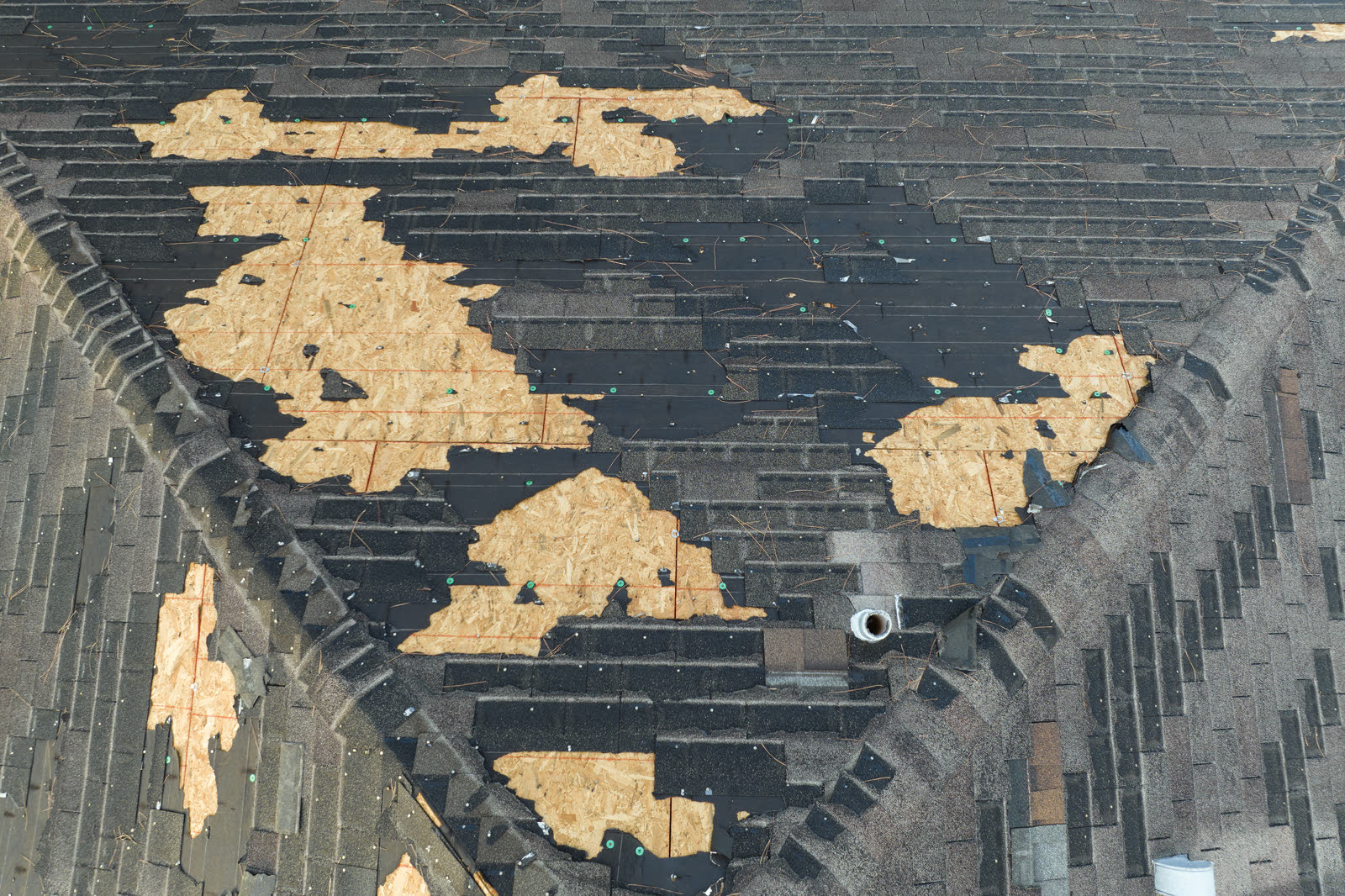
- Stripped or lifted field. Wind tears off or folds back shingles and tiles, exposing underlayment or bare deck. Even shingles that reseal after lifting have broken their seal strip, leaving a compromised, no-longer-watertight zone.
- Debris puncture. A wind-borne branch, panel, or tile from another roof punches a hole clean through the covering and often the deck.
- Flashing and edge failure. Wind peels valley metal, drip edge, or wall flashing, opening the joints where leaks concentrate.
- Window and door breach. The envelope is not only the roof. A window taken out by pressure or debris is an opening the rain enters just the same, and the coverage analysis is identical.
Once any of these opens, wind is also what drives the water in. A hurricane can push rain nearly horizontal at storm-force speed. That rain does not fall onto the opening; it is forced through and under it, driven deep along the deck and into wall cavities far from the breach. That is why interior water damage from a wind-created opening spreads well beyond the room under the hole, and why tracing the water back to its entry point is the core of the proof.
Breach to interior: the sequence a covered claim follows
Coverage tracks a sequence, and every step of it is provable evidence. The carrier's denial tries to cut the chain at one link, usually by attacking the opening. Here is the covered path from wind to water stain.
Every link is a piece of evidence
Interior water is covered when this chain holds end to end. The denial usually attacks link 2, the opening. Documenting all five links keeps the chain intact.
Break any link and the carrier denies. Prove link 2, that wind made the opening, and links 3 through 5 follow it into coverage.
RAIN-LIMITATION STRUCTURE PER TYPICAL HO-3 WORDING · READ WITH SEBO (FLA. 2016)
The clause your evidence has to satisfy
One clause decides most of these claims. It is written as an exclusion with a built-in exception, and the exception is the whole ballgame.
THE RAIN LIMITATION · ISO HO 00 03 04 91, PERILS INSURED AGAINST"This peril does not include loss to the property contained in a building caused by rain, snow, sleet, sand or dust unless the direct force of wind or hail damages the building causing an opening in a roof or wall and the rain, snow, sleet, sand or dust enters through this opening."
Read the structure. The default is that rain damage is excluded. Then the exception restores it, but only on two conditions joined by "and": (1) the direct force of wind or hail damaged the building and created an opening, and (2) the rain entered through that opening. Meet both and the interior water is covered. The carrier's denial always attacks the first condition, because if there was no wind-created opening, the exception never triggers and the exclusion stands. That is why on this claim the opening is not a detail. It is the case.
THE DENIAL, IN CARRIER WORDS"Our inspection found no wind-created opening in the roof covering. The interior water damage is attributed to wind-driven rain penetrating the existing roof system and is therefore excluded."
What the doctrine makes you show
Courts and adjusters call the exception the storm-created-opening doctrine: interior rain damage is covered when a storm's wind or hail first created an opening in the building, and rain then entered through it. Three points make it work in practice:
- The opening need not be dramatic. A stripped shingle zone exposing underlayment, a lifted field that broke its seal, a peeled flashing: these are openings. A through-and-through hole is sufficient but not required; a compromised, no-longer-watertight envelope qualifies.
- The opening and the interior water are one loss. If the roof damage is a covered wind loss, the water it admitted is part of the same loss. Carriers gain leverage by separating them, conceding the roof, denying the water. The counter is to reconnect them through the water path.
- Location and freshness carry the proof. A fresh breach (bright, unweathered fracture surfaces; matching debris) on the loss date, sitting directly up-slope of the interior stain, is the storm-created opening the doctrine requires.
Concurrent causation: the Sebo backstop
Real roofs rarely fail from a single tidy cause. The carrier will point to an older flashing, a prior repair, or a worn seal and argue that non-storm condition, not the wind, let the water in. Florida law answers this with the concurrent-causation doctrine, settled by the Florida Supreme Court in Sebo v. American Home Assurance Co. (Fla. 2016). The rule: where two or more causes combine to produce a loss under an all-risk policy, and at least one is a covered peril, the loss is covered, even if another contributing cause would be excluded on its own.
Applied here: if hurricane wind created or widened the opening that admitted the rain, the interior water is covered under Sebo even if an aging flashing also contributed. The carrier cannot subtract the covered wind cause by pointing at an excluded companion cause. South Carolina reads causation more from the policy's own anti-concurrent-cause and ensuing-loss wording, so the specific clause language matters more there. But in both states the analysis returns to the same fact: did wind breach the envelope?
When the carrier denies it: where the fight lives
Understanding the roof is step one. When the carrier has actually denied your interior water as "wind-driven rain," the work shifts from explanation to proof, and that fight has its own dedicated guide. The wind-driven-rain denial guide walks the burden of proof, the weather-data pull, the scoping arguments, and the engineering opinion that reconstructs a storm-created opening after the fact. Two neighboring fights overlap it:
"Wind-driven rain: no opening"
The proof burden, weather records, and the engineering opinion that establishes the storm-created opening after tarps and repairs.
The counter-guide →"Wear and tear, not wind"
When the carrier says the opening itself is old, the wind-vs-wear signature analysis dates the breach to the storm.
The explainer →Florida vs. South Carolina
Sebo (Fla. 2016): a covered wind cause is not erased because an excluded condition also contributed to the water intrusion.
1 year to notice, 18 months supplemental (§ 627.70132); 60-day pay-or-deny decision (§ 627.70131).
The storm-created-opening exception is the coverage hook; the opening is the contested fact.
Anti-concurrent-cause and ensuing-loss wording is read closely; the exact clause often decides the water claim.
"Prompt notice" per policy; reasonableness standard for payment; 3-year suit-limitation period.
Coverage still turns on whether wind breached the envelope before the rain entered.
STATUTES SUMMARIZED JULY 2026
Statutes and case summaries summarized as of July 2026. Policy wording controls; read your policy and verify current law before relying on it.
Proving the opening: the questions everyone asks
What photos prove a storm-created opening?
Shoot every roof slope and every elevation before tarps or repairs, close up, with something in frame for scale: lifted or creased shingles, displaced tiles, exposed underlayment, peeled flashing, debris strikes. Then shoot the interior end of the same event: the attic below the breach, deck staining, wet insulation, and the ceiling or wall stain. The pair is what matters. A roof photo alone proves damage and a stain photo alone proves water; the two together, with a moisture reading between them, prove the path the policy asks about.
What is a "storm-created opening"?
It is the requirement, written into the rain limitation of most homeowners policies, that the direct force of wind or hail first damage the building and create an opening in a roof or wall, and that the rain then enter through that opening. The opening is the hinge of the whole clause. If wind made the hole and rain came through it, the interior damage is covered. If the carrier can argue no opening existed, that the rain penetrated an intact roof, it denies the water while sometimes still conceding the wind.
The carrier admits wind damaged my roof but denies the interior water. How is that consistent?
It usually is not, and that inconsistency is the pressure point. If wind damaged the roof enough to be a covered loss, that same damage is what let the rain in. The opening and the interior water are one event. Carriers separate them by arguing the roof damage did not create an actual through-opening, or that interior staining is old. Proving the opening (its location, that it is fresh, and that the interior water path leads back to it) reconnects what the denial split apart.
Does it matter that the rain was "wind-driven" specifically?
The phrase is a carrier framing, not a coverage category. "Wind-driven rain" is used two ways: legitimately, to describe rain forced through a wind-created opening (covered), and as a denial label suggesting rain was merely blown against an intact, undamaged surface and seeped in on its own (denied). The physics that matters is the opening, not the wind speed of the rain. Do not let the label decide the claim. Find the opening.
How do I prove wind created the opening if the roof has already been tarped or repaired?
Documentation taken before repairs is ideal, which is why the first photos matter so much. After the fact, the opening is reconstructed from evidence: the tarp itself marks where the breach was, the roofer's or engineer's notes describe the fresh damage, the interior water path traces back to a specific roof location, and weather data confirms wind capable of the breach on the loss date. An independent inspection ties these into a single storm-created-opening narrative.
Florida changed its wind-driven-rain rules. Does that affect my claim?
Coverage for interior water still turns on the policy's rain limitation and the storm-created-opening requirement, read against Florida's concurrent-causation doctrine from Sebo v. American Home Assurance (Fla. 2016). Statutory notice deadlines apply (1 year to notice, 18 months supplemental, Fla. Stat. § 627.70132), and the specific policy wording controls. Because forms and interpretations shift, verify your policy's current language and consult counsel on your facts.
- ISO FORMISO Homeowners 3 Special Form (HO 00 03 04 91): the rain limitation quoted on this page, Perils Insured Against, Windstorm or hail ↗
- FLA. 3D DCAMorales v. Citizens Prop. Ins. Corp., No. 3D21-276 (Fla. 3d DCA Mar. 16, 2022): contractor affidavit on wind-created openings defeats summary judgment ↗
- FL SUPREME CTSebo v. American Home Assurance Co., 208 So. 3d 694 (Fla. 2016): concurrent-causation doctrine for all-risk first-party claims ↗
- FL LEGISLATUREFla. Stat. § 627.70132: notice of property insurance claim (1 year to notice, 18 months supplemental, from the date of loss) ↗
- FL LEGISLATUREFla. Stat. § 627.70131: 7-day acknowledgment, 30-day inspection, 60-day pay-or-deny, written explanation of the policy basis ↗
- NOAA / NCEINOAA NCEI Storm Events Database: official Storm Data records, searchable by state and date range, with event narratives ↗
- NOAA / NHCNHC Tropical Cyclone Report: Hurricane Ian (interior-water losses at scale) ↗
- SC DOISC Department of Insurance: consumer complaint filing, market assistance, and hurricane preparedness resources ↗
Statute summaries drafted August 2026 and simplified for education; verify against current statute. Not legal advice; consult an attorney about your specific claim.
The opening is proved with paper, not argument
The opening is a fact you document, not a position you assert. Start on the roof: every slope, every elevation, close up, before the tarp goes on, with something in frame for scale. A lifted shingle, a torn membrane, a blown-off ridge cap, a broken tile, a displaced flashing all count, and a small breach can admit a large volume of water over a multi-hour storm, so photograph the small ones too. Freshness is what dates the damage: bright, unweathered fracture surfaces are how a storm breach is separated from the wear framing built in wear and tear vs wind.
Then link the breach to the damage, because linkage is the part carriers attack. Photograph the exterior opening and the interior staining together and trace the water path between them, following the photo protocol. The water damage inside is generally part of the same covered loss when wind made the opening, and wind and hurricane coverage governs the opening itself. Roof types fail differently, so check flat roofs for membrane tears at seams and edges. Once the file is built, the coverage argument runs on the wind-driven-rain denial guide, and the review below tests it against your letter.
Photos in hand, and the carrier still says "no opening"?
Upload the denial letter and your photos of the roof and the interior. You'll get a straight answer on whether the "no opening" call holds up against your evidence, and on what is still missing from the file.

 HURRICANELAW.PRO
 A comprehensive property-insurance claim resource for policyholders: denied and underpaid claims, coverage and bad-faith law, storm dossiers, carrier profiles, city guides, and the complete claims playbook. Florida and South Carolina.
▸ SEE THE FULL SITE MAP →Coverage summaries, policy-language quotations, dollar figures, deadlines, and chart examples throughout this site are general information based on typical or standard policy forms and are illustrative only: they are not a quote, a guarantee of coverage, or a promise of any outcome. Every insurance policy is different: your own policy, endorsements, and state law control, so read your policy and confirm current statutes. Weather imagery courtesy of NOAA, the National Hurricane Center, and the National Weather Service. Legal services are provided by Halversen Law. Nothing on this site is legal advice; consult an attorney about your specific claim.
Legal matters are handled by Halversen Law, a law firm licensed in Florida and South Carolina.